Poker bots and RTA, explained
A bot plays for you. RTA plays with you. A solver studies for you. They're constantly confused, they carry very different risks, and only some of them are cheating. Here's the honest breakdown.
Bot = robot player, no human. RTA = human cheating with a solver’s live help. Solver = the study tool behind both.
Solvers off the table are allowed and encouraged; the same solver queried mid-hand is banned RTA.
RTA is harder to catch than a pure bot because a real person still controls the mouse.
Detection watches behavior, mouse path, click rhythm, reaction timing, not just the cards.
Working, durable setups are maintained software, never a cheap public download.
Bot, RTA, solver, HUD: keep them straight
These four words get used interchangeably in forum arguments, and the confusion hides the fact that they sit at very different points on the line between studying and cheating.
A bot is fully autonomous software. It reads the screen, computes a decision and clicks the buttons with no person involved, and it can do this on many tables at once, around the clock. RTA (real-time assistance) keeps a human in the chair while a solver feeds them the optimal play as the hand runs. It amounts to a perfect bot operated by a person, which is what makes it harder to catch: a real hand moves the mouse.
A solver such as PioSOLVER or GTO Wizard is analysis software, nothing more, and a HUD is an overlay showing opponent statistics pulled from a tracking database. Neither is inherently cheating. The bright line is timing, not the tool. A solver used away from the table is ordinary study; the same solver queried during a live hand is banned RTA. HUD rules are site-specific: GGPoker bans third-party HUDs outright, and anonymous tables exist largely to neuter them.
How a bot actually runs
Every bot, however sophisticated, runs the same loop, and each step it takes to look human is also a place it can slip.
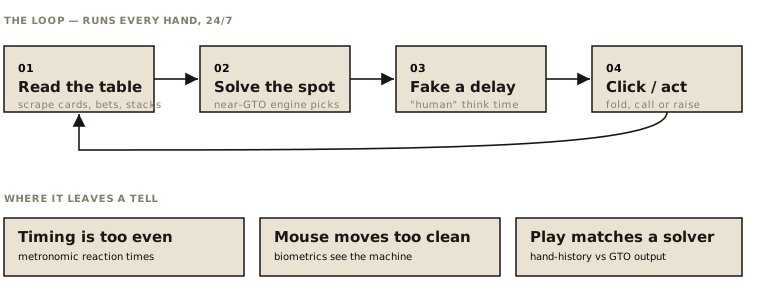
A poker bot has three broad jobs. It reads the table state from the screen, chooses an action, then sends the click. The decision layer may consult a near-GTO engine or a precomputed strategy. Commercial bots use solver software that anyone can license; they are not secret descendants of Libratus or Pluribus, the research systems that were never sold. “Bot” describes the automation around the decision-making, not a particular solver.
The harder problem is passing as human. Automation can pause and move a cursor, but rooms analyse reaction times and input patterns — mouse speed, acceleration, path, click cadence and dwell. Repeatedly precise movements are suspicious, and so are supposedly humanised delays whose randomness is statistically too uniform. A strategy may play very strong poker, yet the wrapper still has to imitate someone distracted, tired and inconsistent at 2am. That performance is often where detection starts.
Are the “AI” bots any good? Less than the hype
It’s worth separating two things the marketing blurs together. Most durable bots don’t “think” at all in the ChatGPT sense; their decision layer is a solver or a precomputed strategy, a lookup table that returns a near-GTO action for the spot. That’s boring and it’s effective. Ask it anything and it answers instantly with a defensible play, because the poker was solved offline, long before you sat down.
The bots that actually run a large language model live, at the table, are a different and much weaker animal, and the honest picture cuts against the “unbeatable AI” pitch. A 2026 study accepted at ICLR, How Far Are LLMs from Professional Poker Players?, put frontier models head-up against a solver and found they lose — the models still finish underwater over thousands of hands. The researchers name the culprit a knowing-doing gap: the model reasons its way to the correct play in words, then chooses a different action anyway, and no amount of prompt-tuning reliably closes it.
Why RTA is the harder problem for sites
A bot’s primary vulnerability is faking humanity. Security systems track biometric inputs like mouse acceleration and cursor paths, and when automated software tries to humanise its clicks with random delays, the results often flag as statistically too uniform. Real-time assistance bypasses this completely: because a human manually enters the solver’s dictated actions, their physical inputs and rhythms are genuine.
Instead, RTA leaks through timing and decision quality. A mid-stakes player might suddenly never misplay a complex river spot, or their hardest decisions will consistently take the exact same beat because they are reading outputs from a second screen. Operators explicitly cite identical reaction times as a key metric for flagging these accounts. To catch RTA, security teams rely on post-hoc analysis, running suspicious hand histories through solver fingerprinting to compare a player’s choices directly against known optimal outputs.
How fast do they get caught
Detection has shifted from tracking what players do to measuring how they do it. Modern systems analyse mouse acceleration, click cadence and reaction times, flagging the statistical uniformity that bots and real-time assistance tools often display. GGPoker, working with GTO Wizard, matched player decisions against solver logs and banned 31 accounts — a move that also barred those players from the 2025 WSOP. This approach exposes the subtle fingerprints of automation that older filters missed. The detection page covers the mechanics in full.
Keeping a cheating setup viable now demands constant updates as sites refine their behavioural models. A static script or a one-off forum file rarely survives long against these dynamic checks. The ground is shifting toward biometric and decision-pattern analysis, making it significantly harder to mimic human variance without leaving a trace — which is why, if you’re weighing what’s real, you should start with our guide to spotting bot scams.
Want to understand what a serious setup really involves?
There's a wide gap between a $30 forum download and software that's maintained to survive a modern integrity team. If you're past the videos and want a straight answer about what's real in 2026, talk to someone who runs it.
Telegram groupWhat's the difference between a poker bot and RTA?
A bot plays entirely on its own: it reads the table, decides, and clicks with no human involved. RTA — real-time assistance — keeps a human in the seat who consults a solver during the hand and copies its answer. A bot is a robot player; RTA is a human cheating with a robot's help. RTA is usually harder to detect because a real person is still moving the mouse.
Is using a solver cheating?
It depends entirely on when. Running a solver like PioSOLVER or GTO Wizard away from the table to study is not just allowed, it's how serious players train. Querying that same solver during a live hand to decide your action is real-time assistance, and it's banned on every major site. The tool is the same; the timing is the crime.
How quickly do poker bots get caught?
It varies, but the trend is clearly against the bot. Sites now profile mouse movement, click timing, and reaction consistency, then compare play against solver output after the fact. Cheap, unmaintained bots get flagged relatively fast. The ones that last are carefully run and constantly updated, which is exactly why they're never sold as a simple public download.
Are free or cheap poker bots real?
Almost never. A working bot that survives detection is expensive to build and maintain. The free and cheap ones advertised openly are overwhelmingly non-functional, malware, or outright scams that take your money and deliver nothing. See our page on spotting bot scams.
Every figure and case on this page traces to a published report. Operator PR is flagged as PR; anything unproven is marked an allegation.
- How Far Are LLMs from Professional Poker Players? — frontier models lose to a solver, the 'knowing-doing gap' (ICLR 2026)
https://arxiv.org/abs/2602.00528 - GTO Wizard AI poker benchmark — frontier LLMs measured against a solver
https://gtowizard.com/benchmark - GGPoker x GTO Wizard — 31 accounts banned for live solver use, barred from 2025 WSOP
https://www.gamblingnews.com/news/ggpoker-bans-31-players-for-illegal-rta-use/