How poker sites catch bots and cheats
Modern detection barely looks at your cards. It looks at how you move, how fast you decide, and whether your play matches a solver a little too well. Here's the stack, and the seven-figure numbers behind it.
Detection runs in layers: signup fingerprinting, in-hand behavior, and post-game analysis.
Behavioral biometrics read mouse path and click cadence, machines move too cleanly.
Timing analysis flags reaction times that are metronomic or identical.
Solver fingerprinting compares your play to a solver’s; GGPoker + GTO Wizard banned 31 accounts.
Caught on a licensed site means a seized balance and, increasingly, a cross-network ban.
The stack: four places you can be caught
Integrity teams don’t rely on a single test. They layer independent checks so that beating one doesn’t get you through, and each layer catches a different kind of tell.
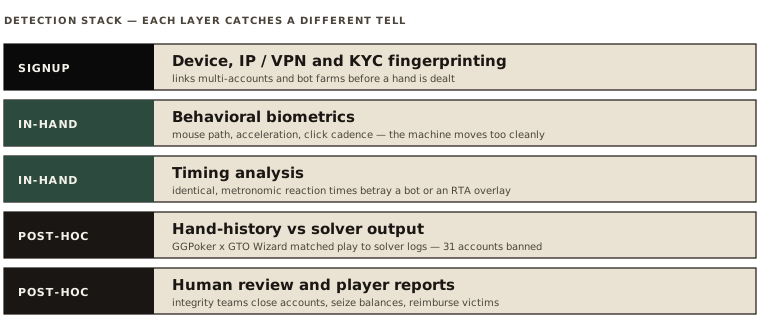
Detection begins at the account stage. Operators cross-reference device IDs, IP addresses and payment details to link multi-accounts and bot farms. When a player uses a VPN or shares a device with another account, the system flags the connection. This layer catches the infrastructure before a single hand is dealt.
On mobile — where most club-app cheating lives — the device gives up far more than an IP. The signup and login flow reads the whole environment: the Android or iOS build, the reported GPS position, the type of mobile network, even the battery level, and it checks all of it for the fingerprints an emulator leaves behind. A datacentre IP where a residential one should be, a GPS location that contradicts the IP, or accelerometer readings frozen at zero (a real phone is never perfectly still; an emulator is) are the kind of mismatches that fraud vendors like SEON describe as the industry-standard tells. None of this happens at your table. It happens on a server correlating the whole network at once.
Once seated, the software watches how you play. Behavioural biometrics track mouse acceleration, path curvature and click cadence. A human hand moves with natural jitter; a bot or script often produces paths that are too smooth or statistically uniform. Timing analysis adds another filter: if reaction times remain identical across dozens of hands, the system flags the account for review. PokerStars has cited this specific pattern as a primary indicator of automated play.
The final check happens after the session. Algorithms compare a player’s decisions against known solver outputs. In 2025, GGPoker banned 31 accounts for using solvers during play, with decisions matching GTO Wizard logs too closely to be coincidence. This post-hoc analysis confirmed the player was not making independent choices.
None of these layers works alone. A single suspicious signal rarely triggers a ban; the system stacks them, device telemetry, IP history, timing and solver-match, into a risk score, and it’s the score, not any one tell, that decides whether an account is closed outright or handed to a human for manual review. That’s why “beating the mouse-movement check” is not the same as beating detection. You’re not fooling one gate. You’re fooling a system that gets a second, third and fourth opinion on you from angles you can’t see.
The traps you don’t see
The layers above are passive — they watch. Rooms also run active tests that most players never notice firing.
The oldest is the chat test. An administrator opens a conversation mid-session, or during a complex hand, and watches for a reply that’s too slow, too templated, or oddly off-topic. It’s cheap, it’s crude, and it’s aimed squarely at the fully-automated bot with no human in the loop.
The subtler ones target the software directly. To beat bots that read the table by taking screenshots and running image recognition, some clients now jitter their own graphics, nudging cards and buttons a few pixels at random each hand, invisible to you, quietly poisoning any bot that expects fixed coordinates. Others deliberately move the furniture: shifting a button’s position, or swapping the order of Call and Fold, on the theory that a human adjusts in a heartbeat and a script that taps a memorised coordinate walks straight into the wrong action and outs itself.
Detection is wildly uneven across the industry
Here’s the caveat the marketing on both sides leaves out: everything above describes the top of the market. Server-side machine learning, device telemetry and network-wide cluster analysis are expensive to build and run, and in practice they’re the province of maybe the top five to ten public rooms: the GGPokers and PokerStars of the world.
Drop down to the agent-run club apps and the picture inverts. The club owner policing your game frequently has no access to that telemetry at all; the app keeps device data at the platform level, not the club’s. What’s left is manual: eyeball the hand histories, field player complaints, ask a suspect for ID. That gap is exactly why club apps are the softest targets in poker, and why a setup that would be flagged in an afternoon on a licensed site can grind for months in a private club. Detection didn’t vanish. It just got a lot dumber, and a lot slower, the moment you left the regulated rooms.
The numbers, in public, on purpose
For years, most operators treated cheating enforcement as something to be handled quietly in the back office. That has flipped. GGPoker now publishes full RTA sweeps, and in a separate joint effort with GTO Wizard it matched play histories to solver logs, banned 31 accounts for live solver use and barred those players from the 2025 WSOP. The point is not subtle: if you cheat, they want you to assume they have the tools and are willing to use them.
Other rooms follow the same script at different scales. In the high-profile Ali Imsirovic case, multi-accounting cost him $320,000. PokerStars goes further with marketing: it publicly claims a very high proactive RTA detection rate, but that figure is self-reported and not independently audited. Treat it as the operator’s own number rather than an audited one — the direction, though, is unmistakable. The teams are bigger, the tools are better, and the bans are louder.
What this means if you’re weighing the risk
The calculation has shifted against anyone weighing up a bot. The old idea that a clever program just needs to “act human” is out of date: sites now score mouse movement, click cadence and reaction timing continuously, and the “humanised” random delays added to bots are flagged as statistically too uniform. Solver fingerprinting compares your actual decisions against solver output, and historical solver-run logs can be pulled as evidence.
Getting caught is not a warning or a suspended account. Balances are seized and redistributed, and blacklists carry across partner networks into live events. The setups that survive are actively maintained against each new detection wave, which is why none of them is a public download — and why most of what is sold openly is a scam.
How do poker sites detect bots?
In layers. At signup, device, IP, VPN and identity checks link multiple accounts and bot farms. During play, behavioral biometrics profile mouse movement and click timing, and timing analysis flags reaction times that are too consistent. After the fact, sites compare hand histories against solver output and review flagged accounts by hand. A cheat only has to fail one layer.
Can poker sites detect RTA?
Increasingly, yes. Because a human still plays, RTA dodges some behavioral tells, so sites lean on decision analysis: comparing a player's choices in hard spots against what a solver would do. GGPoker did this in partnership with GTO Wizard and banned 31 accounts. PokerStars publicly claims a high proactive detection rate, though that figure is the operator's own.
What happens to your money when you're caught?
On a licensed site: the account is closed and the balance confiscated, then commonly redistributed to the players who were cheated. GGPoker confiscated over $1.1 million in one sweep and refunded 4,329 players. Bans are increasingly cross-network, so a GGPoker ban can also bar you from live events like the WSOP.
Do 'humanized' bots beat detection?
Adding random delays and jittery mouse paths helps against crude checks, but it creates a new problem: the randomness itself is statistically too uniform. Real human behavior is messier and more context-dependent than a randomizer. Modern behavioral systems are trained to spot the tell-tale evenness of fake humanity.
Every figure and case on this page traces to a published report. Operator PR is flagged as PR; anything unproven is marked an allegation.
- GGPoker RTA sweep — 40 accounts, $1,175,305 confiscated, 4,329 reimbursed
https://www.pokerindustrypro.com/news/article/211757 - GGPoker x GTO Wizard — 31 accounts banned for solver use, barred from 2025 WSOP
https://www.gamblingnews.com/news/ggpoker-bans-31-players-for-illegal-rta-use/ - partypoker — 291 bot/fraud accounts closed, $71,771 returned (2024)
https://rakerace.com/news/poker-rooms/2025/04/14/behind-the-scenes-partypoker-s-biggest-crackdown-on-bots-in-recent-years - CoinPoker — 98 bot-linked accounts banned, $156,446 redistributed (2026)
https://coinpoker.com/news/bots-banned-players-refunded/ - PokerStars anti-RTA program and 'identical reaction times' detection
https://www.pokernews.com/news/2023/10/pokerstars-battle-against-real-time-assistance-44628.htm - Behavioral biometrics against automated fraud (method background)
https://seon.io/resources/behavioral-biometrics-against-fraud/ - How to detect a poker bot farm — device telemetry, emulator traces, geo/IP mismatch (SEON)
https://seon.io/resources/how-to-detect-a-poker-bot-farm/