Club-app poker cheats: ClubGG, Pokerrrr2, PokerBros and WePoker
PPPoker isn't the only agent-run app, and they all share the same design flaw. Here's how ClubGG, Pokerrrr2, PokerBros and WePoker actually work, and why the model itself is the vulnerability.
Agent-run apps license the software but not the game, clubs and money are run by agents.
ClubGG is GGPoker-owned but unlicensed and play-money; the club-model risk still applies.
WePoker (茶馆 “teahouse”) has no license and sometimes verifies players only after thousands of dollars.
Weak identity checks plus off-platform money is the exact recipe that attracts bots and collusion.
Your safety depends on your agent’s honesty, with no operator above them to appeal to.
The same machine in different cases
Once you understand why PPPoker’s structure is the risk, ClubGG, Pokerrrr2, PokerBros and WePoker stop looking like separate ecosystems. The same basic design keeps reappearing: a company provides a play-money poker client, independent agents create clubs, and deposits and withdrawals are handled off-app. The platform does not act as the real-money cashier, which is the legal distinction on which the model relies.
That separation also breaks the normal chain of accountability. A licensed room holds player funds, performs KYC and runs a central integrity team. On club apps, agents may control access, balances and dispute resolution, while enforcement is often left to the club itself. Weak or delayed KYC makes bot farms and multi-accounting easier, and an agent suspected of cheating may also be the person deciding whether to investigate.
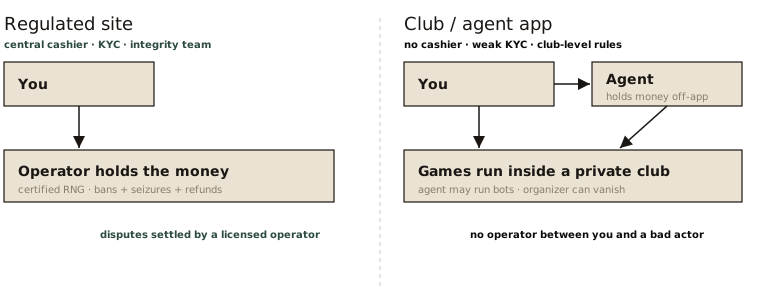
Four apps, one flaw
These four apps share a structural vulnerability: they operate outside standard gambling regulation through a play-money loophole. Even ClubGG, owned by the regulated giant GGPoker, holds no actual gambling licence. It carries a BMM-certified random number generator for its shuffle, but that certification only covers the software, not the individual clubs. The trusted parent brand does not buy you a regulator.
Pokerrrr2 and PokerBros run on the same agent-led model as PPPoker. Real money changes hands off the platform, and because the apps just host play chips, your security rests entirely on whichever agent you joined. If they ignore a cheating dispute or run bots themselves, you have no central authority to call.
WePoker, a Chinese “teahouse” (茶馆) app, leaves players highly exposed. It operates globally with no licence and minimal identity checks — some pools only require verification after a player moves roughly $5,000. That delay makes it trivial for multi-accounting rings to establish fresh accounts and extract funds before having to prove who they are.
What actually threatens you here
The core threats in club apps mirror those on regulated sites: bots and real-time assistance, multi-accounting and collusion. What changes is the environment. Weak identity checks let bot farms scale cheaply, while off-platform settlements let players disguise chip dumping as routine transfers between agents. In this model the agent holds disproportionate power — they control the lobby, manage the bankroll, and often act as the sole point of contact for disputes. That creates a conflict of interest where the person you must complain to may be the one running the bots or coordinating the soft play.
Documented collapses show the risk. When PPPoker unions like Diamond Union or Apex Union imploded, players lost millions because there was no central authority to enforce rules or recover funds. Unlike licensed rooms with dedicated integrity teams, these clubs rely on agent governance. If an agent runs a bot farm or orchestrates a multi-accounting ring, the victim has no recourse beyond the agent’s own ledger. The structure itself, not a missing patch, enables the fraud.
There’s a second, quieter reason these apps are the soft underbelly of online poker: the detection simply isn’t there. The server-side machine learning and device telemetry that licensed rooms use to hunt bots is expensive, and it belongs to the platform, not the club. The agent running your game often can’t see any of it — the app keeps that data at its own level, so the only tools left at the club are the crudest ones: read the hand histories by eye, wait for a complaint, ask a suspect for a photo ID. A bot that a licensed room would score and close in an afternoon can quietly grind a private club for months.
That enforcement vacuum is also what makes the club the natural home of the eco-bot: a bot built not to beat you but to keep the tables full and the rake flowing. On a licensed site its telemetry would give it away; in an agent-run club, with no one looking at telemetry, it just looks like another friendly fish who never logs off.
If you play these apps, read the detection tells, assume any “undetectable” tool sold to you is a scam until proven otherwise, and never leave more with an agent than you’d accept losing with no recourse. On a club app, no recourse is the default.
Stuck in club games that don't feel straight?
If you play the club apps and want to understand what's really happening in your games — and what a serious setup looks like versus the scams — talk to someone who knows the ecosystem.
Telegram groupWhich poker club apps get cheated the most?
The agent-run apps as a class: PPPoker, Pokerrrr2, PokerBros, Upoker and the Chinese 'teahouse' apps like WePoker. They share the same weakness — no central operator holds the money or polices the games — which makes bots, collusion and vanishing organizers far easier than on licensed sites.
Is ClubGG safe? It's owned by GGPoker.
ClubGG is owned by GGPoker but holds no gambling license and runs on play chips, so it isn't the same as playing on regulated GGPoker. It carries an RNG certification from a testing lab, but games are still governed at the club and agent level rather than by a licensed operator's cashier and integrity team. The structural risk of the club model still applies.
What is WePoker and why is it risky?
WePoker is a Chinese 'teahouse' (茶馆) club app with no gaming license and minimal identity checks — some pools only verify a player after they've moved thousands of dollars. Weak KYC plus off-platform money plus global access is the exact recipe that draws bot farms and collusion rings.
Are Pokerrrr2 and PokerBros legit?
The apps function as advertised, but 'legit' is the wrong frame. Like PPPoker, they're platforms where independent agents run clubs and handle money off-app. Whether your specific club is honest comes down to your agent, not the app — and there's no operator above the agent to appeal to if it isn't.